
Same Day Online Fix: Get Out of a Title Loan Without Losing Your Car

Yes, you can get a same-day online title loan with bad credit if you own your car free and clear, live in a state that permits title lending, and can produce the right paperwork fast. Many lenders typically fund approved applications the same day. Expect to hand over your clear title, a photo ID, proof of insurance, proof of income, and vehicle photos, and expect the cost to be steep. Read the Truth-in-Lending disclosure and confirm state licensing before you sign anything.
TL;DR:
- Title loans typically cover 25% to 50% of your vehicle’s value, with state caps influencing the maximum loan amount regardless of car worth.
- Approved applications can be funded on the same day if you prepare and submit clear documents like your title, ID, proof of income, insurance, and vehicle photos.
- Repossession occurs in about one in five cases if borrowers fail to repay within the short-term loan period, often leading to additional fees and possible deficiency balances.
- The overall cost can reach an annualized 300% APR when including fees and rollovers, making these loans significantly more expensive than most alternatives.
- Safer options like credit union loans or personal loans should typically be considered first, as title loans are best only when no other affordable solutions are available.
Table of Contents
- How to Get Out of a Title Loan Application Fast: What It Is and Who Qualifies
- How Does the Online Same-Day Application Process Work?
- What Documents Do Lenders Actually Check?
- What Do Title Loans Actually Cost, and What’s the Repossession Risk?
- Are There Safer Alternatives, and When Does a Title Loan Make Sense?
- How Cash Title Express Handles Same-Day Online Applications
- Strategies to Repay or Refinance a Title Loan Early
- How to Negotiate Better Terms or a Payoff Deal With Your Lender
- What Rights Do Borrowers Have Before Repossession Happens?
- Avoiding Unfair Fees and Disputing Loan Practices
- How Defaulting on a Title Loan Affects Your Credit and Finances
- Where to Find Debt Counseling and Legal Aid for Title Loan Problems
- Author perspective: when this loan makes sense, and when to walk away
- If You Decide to Apply Now, Start Here With Cash Title Express
- Sources
- FAQ
How to Get Out of a Title Loan Application Fast: What It Is and Who Qualifies
A car title loan is a short-term loan secured by your vehicle’s title instead of your credit history. That’s the entire pitch: hand over the title as collateral, get cash, keep driving the car. Terms typically run 15 to 30 days, though many lenders offer renewal or installment structures that stretch repayment further.
Loan amounts usually land between 25% and 50% of your vehicle’s appraised value, and most states cap how much a lender can extend regardless of what your car is worth. Eligibility hinges less on your credit score and more on paperwork:
- A clear, lien-free title registered in your name
- Proof of steady income, whether from a job, benefits, or regular deposits
- A vehicle in working condition that passes a photo or in-person inspection
- Residency in a state where title lending is legal and licensed
That last point trips people up. Some states ban title loans outright or cap rates so low that few lenders operate there, so checking your state’s rules before you spend an hour filling out forms saves real frustration.
How Does the Online Same-Day Application Process Work?
Speed comes from preparation, not luck. Borrowers who gather everything before they start the form finish faster and hit fewer verification snags.
- Gather your documents first. Clear title, VIN, current odometer reading, government ID, proof of insurance, and proof of income, all photographed or scanned in advance.
- Upload photos and consent to verification. Digital lenders rely on photo-based inspections rather than sending someone to your driveway, which is what makes same-day turnaround possible.
- Review the written offer. Before you accept, check the APR, total finance charge, and total amount repayable, all of which federal law requires lenders to disclose in writing.
- Confirm your funding method. ACH transfer is standard; ask specifically whether same-day deposit is available for your bank.
The full sequence, from submission to signed terms to funds landing in your account, can happen within one business day if your documents are clean and your state permits the loan.
Pro Tip: Photograph your odometer and all four sides of your vehicle in daylight before you start the application. Blurry or nighttime photos are the single biggest cause of manual review delays on otherwise fast approvals.

What Documents Do Lenders Actually Check?
Every lender verifies the same core things, even when the online forms look different from one site to the next.
- The title itself. It has to be in your name with no lien attached, or the lender needs a clear process for satisfying an existing lien before funding.
- Government-issued ID and proof of residence. A driver’s license plus a recent utility bill or lease covers most requirements.
- Proof of insurance and proof of income. Pay stubs, bank statements showing regular deposits, or benefit statements all typically qualify.
- VIN and odometer reading, cross-checked against your photos to confirm the car matches the title.
- Vehicle condition photos, sometimes including duplicate keys or disclosure of any tracking or disabling device installed as a condition of the loan.
Salvage titles, existing liens, and unresolved judgments against the vehicle are the most common reasons an otherwise qualified applicant gets delayed or declined. If your title shows a salvage brand or a lien from a previous loan, ask the lender directly whether they can work with it. Some can. Many can’t, and finding that out early beats finding it out after a hard credit pull or a wasted afternoon. Requirements vary by state, so what satisfies a lender in one state may not fly in another.
What Do Title Loans Actually Cost, and What’s the Repossession Risk?
Title loans are fast, but they are not cheap by any reasonable measure. Monthly finance charges often run close to 25%, which annualizes to roughly 300% APR once you account for the compounding effect of rolling the loan over. Add origination and processing fees on top, and a $1,000 loan can cost several hundred dollars in fees alone if you carry it for even one renewal cycle.
The Truth-in-Lending disclosure is your best defense here. Federal law requires every lender to spell out the finance charge, the APR, and the total amount you’ll repay, in writing, before you sign. Put two offers side by side and compare those three numbers. Ignore the marketing language.
The repossession numbers are worth sitting with. CFPB research finds that a significant minority of car title loan borrowers end up having their vehicle repossessed (https://www.consumerfinance.gov/archive/newsroom/cfpb-finds-one-five-auto-title-loan-borrowers-have-vehicle-seized-failing-repay-debt/) for failing to repay the debt. That’s not a rare outcome. It’s a one-in-five shot at losing your car, which for most borrowers is also their way to get to work.
There’s a second layer of risk people rarely think about: what happens after repossession.
- If the lender auctions your repossessed car and the sale doesn’t cover your full balance, you can still owe a deficiency balance in many states.
- Deficiency and repossession rules vary significantly by state, so what your neighbor in another state experienced may not apply to you.
- Some lenders install GPS trackers or remote disabling devices as a condition of the loan. Read the agreement for any clause granting the lender vehicle-access rights.
Are There Safer Alternatives, and When Does a Title Loan Make Sense?
Title loans should sit near the bottom of your list, not the top, because cheaper options usually exist if you have even a day or two to look.
- Credit union PAL loans (Payday Alternative Loans) cap rates at levels far below typical title loan APRs.
- Small personal loans, even from online lenders, frequently beat title loan pricing for borrowers with subprime credit.
- Secured loans with longer terms spread payments out and avoid the 15 to 30 day repayment crunch entirely.
- Employer or payroll advances, where available, cost nothing beyond the inconvenience of asking.
- Borrowing from friends or family, while uncomfortable, carries none of the repossession risk.
Consumer finance guidance generally recommends avoiding loans priced above 36% APR when a lower-cost alternative exists, and title loans routinely land nowhere close to that ceiling.
A title loan earns its place only when three things are all true at once: you need cash today, every safer option is genuinely unavailable to you, and you have a real plan to repay the full balance inside the loan term.
Pro Tip: Before you sign anything, add up the total repayable amount from the Truth-in-Lending disclosure and compare it to your next two paychecks. If repayment ate more than a third of that income, you’re setting up a renewal cycle, not a fix.
How Cash Title Express Handles Same-Day Online Applications
Cashtitleexpress runs its process entirely online, offering car title loans from $500 to $50,000 for borrowers with bad credit who need a fast decision without a branch visit.
- Borrowers typically keep driving their car for the entire loan term; the application generally does not require surrendering the vehicle.
- Most offers come in writing with no obligation to accept, allowing borrowers to compare terms before committing.
- Some lenders do not charge pre-payment penalties, which matters if borrowers plan to pay the loan off early once finances stabilize.
- Loans are issued through licensed lenders matched to your state’s requirements, which keeps the terms you’re offered aligned with what your state actually permits.
If you want to see how the underwriting side works before you apply, the approval process for bad credit borrowers walks through what lenders weigh beyond your credit score. And because state rules genuinely change the math, checking your state and city page before submitting anything is worth the two extra minutes.
Strategies to Repay or Refinance a Title Loan Early
Paying off a title loan ahead of schedule is the single best move you can make, since every day the loan runs is another day of finance charges compounding against you.
Start by confirming there’s no pre-payment penalty. Not every lender waives that fee, and one that does remove the biggest obstacle to early payoff. Once you know you’re free to pay ahead, direct any extra income, a tax refund, a bonus, a side gig payment, straight at the principal rather than treating it as spending money.
Refinancing is the second lever. If your credit has improved even slightly since you took out the title loan, or if you’ve built a short track record of on-time payments, ask your lender or a different one about refinancing into a lower-rate personal loan or an installment title loan with a longer term. A longer term at a lower APR often cuts your total finance charge substantially, even though it stretches out the calendar.
Some borrowers also negotiate a partial early payoff schedule, paying down the principal in chunks between the standard due dates. This shortens the loan’s overall interest exposure without needing a full lump sum. Whatever approach you take, get any modified payoff plan in writing before you send money. A verbal agreement about “extra payments” that isn’t reflected in your loan documents can leave you disputing a balance the lender still shows as outstanding.
How to Negotiate Better Terms or a Payoff Deal With Your Lender
Lenders would rather get paid something than repossess a car and deal with an auction, so there’s more room to negotiate than most borrowers assume.
Call before you miss a payment, not after. Lenders are far more willing to adjust terms for a borrower who’s proactively communicating trouble than one who’s already 30 days delinquent. Ask specifically about extending the term, reducing the monthly finance charge, or converting a single-payment loan into an installment structure.
If you have a lump sum but not the full balance, propose a negotiated early payoff for less than the total owed. Some lenders will accept a reduced amount to close the loan cleanly rather than risk a longer, costlier collections process. This works better if you can point to specific hardship (job loss, medical bills) and back it with documentation.
Always get concessions in writing before you pay a cent. A phone call promising “we’ll waive the late fee” means nothing if the lender’s system still shows the fee due next month. Ask for an updated payoff letter or amended loan agreement reflecting the new terms, and keep a copy. If a lender refuses to put anything in writing while asking you to pay immediately, treat that as a warning sign rather than routine business practice.
What Rights Do Borrowers Have Before Repossession Happens?
Repossession rules vary by state, but a handful of protections show up almost everywhere. Lenders generally cannot use force, threats, or a breach of the peace to repossess your vehicle. If a repo agent breaks into a locked garage or physically confronts you to take the car, that typically crosses into illegal repossession territory regardless of what your loan agreement says.
You’re also entitled to advance notice in many states before repossession occurs, along with a right to “cure” the default by catching up on missed payments within a specified window. Once a vehicle is repossessed, most states require the lender to notify you of the sale and, in many cases, give you a final opportunity to redeem the car by paying the full balance plus repossession costs before it’s auctioned.
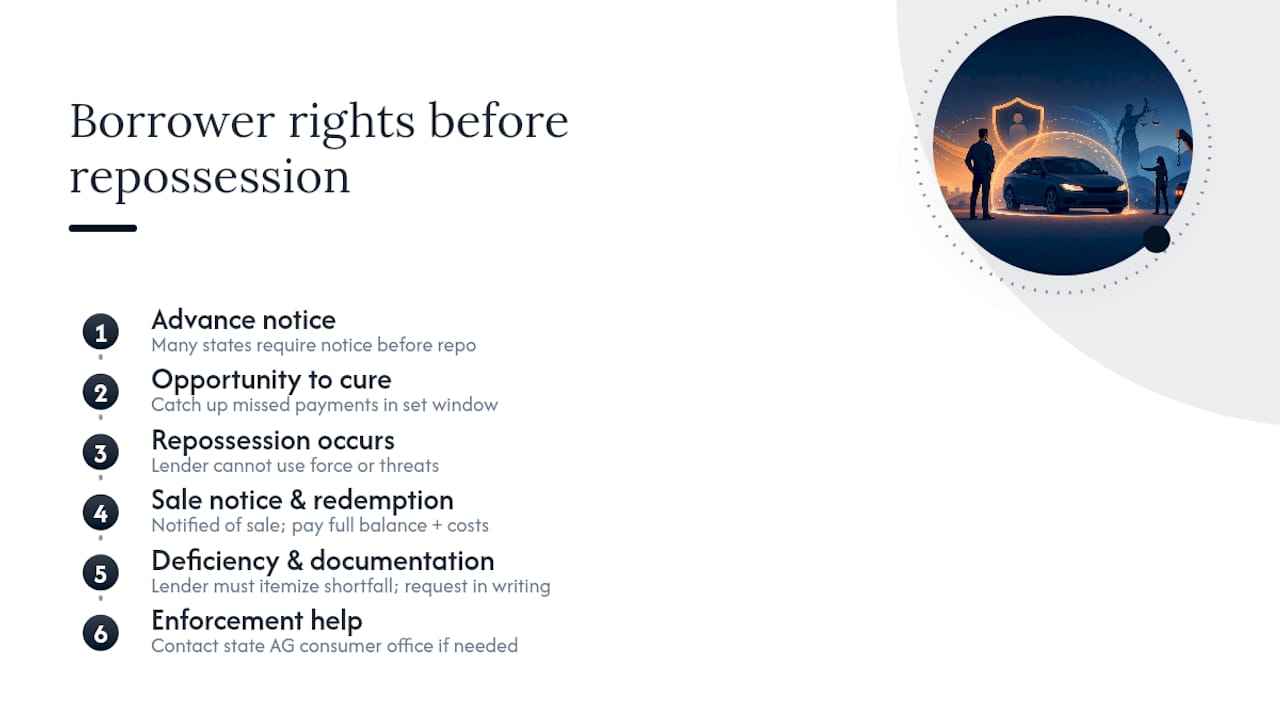
If the vehicle is sold for less than what you owe, the lender may pursue you for the deficiency balance depending on your state’s rules, but they generally must account for the sale price and provide documentation of how the deficiency was calculated. Request that documentation in writing if you’re ever billed for a shortfall. Contacting your state’s attorney general consumer protection office is a reasonable first step if a lender skips required notices or repossesses without proper cause.
Avoiding Unfair Fees and Disputing Loan Practices
The best defense against unfair fees is refusing to sign until you’ve actually read the Truth-in-Lending disclosure line by line. Federal law requires lenders to state the finance charge, APR, and total repayment amount before you commit, and any lender rushing you past that step or waving away questions about it is a lender you should walk away from.
If you’ve already signed and suspect you were charged fees never disclosed at signing, request an itemized breakdown of every charge on your account. Compare it against your original loan agreement and the Truth-in-Lending statement you received. Discrepancies, junk fees added after the fact, “processing” charges that weren’t disclosed upfront, are grounds for a formal dispute.
File a complaint with your state’s financial regulator or attorney general’s consumer protection division if the lender won’t correct an error voluntarily. You can also file a complaint directly with the CFPB, which tracks patterns of lender misconduct across the industry. Keep every piece of correspondence, screenshots of online terms, and copies of your original disclosure. That paper trail is what turns a dispute from your word against theirs into a documented case a regulator can actually act on.
How Defaulting on a Title Loan Affects Your Credit and Finances
Here’s a detail that surprises a lot of borrowers: many title loans aren’t reported to the major credit bureaus at all, so making payments on time usually won’t help your credit score climb. Default, however, is a different story.
If a title loan lender does report to credit bureaus, or sells your defaulted debt to a collections agency that does, that default can land on your credit report and drag your score down for years. Even when the original loan wasn’t reported, a deficiency balance sent to collections after repossession almost always ends up on your credit file eventually.
The bigger financial hit is usually immediate rather than long-term: losing your vehicle. For most borrowers, that means losing the ability to get to work reliably, which compounds the original financial pressure that led to the loan in the first place. A repossession also typically triggers additional fees, towing, storage, and administrative charges, that get added to whatever deficiency balance you may already owe. Between the credit damage, the transportation loss, and the potential deficiency judgment, default on a title loan tends to cost far more than the original loan amount ever provided in relief.
Where to Find Debt Counseling and Legal Aid for Title Loan Problems
If a title loan has already spiraled into a situation you can’t manage alone, free help exists and it’s worth using before the situation gets worse.
Nonprofit credit counseling agencies affiliated with the National Foundation for Credit Counseling offer free or low-cost budget reviews and can sometimes negotiate directly with lenders on your behalf. Legal aid organizations in most states handle consumer debt cases, including illegal repossession claims, at no cost for borrowers who qualify based on income. Searching “legal aid” plus your state name will surface your local office.
Your state’s attorney general consumer protection division is another free resource, especially if you suspect the lender violated licensing rules or repossession procedures. And the CFPB’s complaint database lets you file a formal complaint that gets logged against the lender, sometimes prompting a direct response you wouldn’t get by calling the lender alone. None of these resources cost you anything to try, which makes them worth exhausting before you consider a second high-cost loan to cover the first one.
Author perspective: when this loan makes sense, and when to walk away
Title loans genuinely help people in real crises, but that doesn’t make them a good financial tool most of the time. They’re a last resort, not a first option. Refuse any lender that hides fees, pressures you to sign fast, operates without visible state licensing, or requires you to buy add-on products. Insist on written Truth-in-Lending terms, screenshot everything, and confirm licensing before you commit a dollar.
— Constantine
If You Decide to Apply Now, Start Here With Cash Title Express
Cashtitleexpress gives you a faster path than a branch visit or a stack of paperwork: apply entirely online, get a written offer with no obligation to accept, and keep driving your car while your cash need gets handled the same day.

Before you start, gather your clear title, government ID, proof of insurance, proof of income, and clear photos of your vehicle including the odometer. Having all five ready is what separates a same-day approval from a next-day one. Head to the online car title loans page to begin the application, where you’ll enter vehicle details first, then personal and income information. Every offer comes with a written Truth-in-Lending disclosure spelling out your finance charge, APR, and total repayment amount, and you’re never obligated to accept it. Loans are matched to licensed lenders based on your state, so confirm your state’s specific terms before signing. If you’re ready, start your application today and see your written offer before you owe anything.
Sources
- CFPB: One in five auto title loan borrowers have vehicle seized after failing to repay debt
- What to know about payday and car title loans | FTC
- CFPB releases report on auto repossessions | Consumer Financial Services Law Monitor
This article is general information, not a substitute for advice from a qualified financial advisor. Consult a qualified financial professional about your own circumstances before acting on anything here.
FAQ
Can You Get a Title Loan Funded the Same Day?
Yes, many online lenders including Cashtitleexpress fund approved applications the same day once you submit a clear title, ID, proof of insurance, and proof of income. Approval speed depends heavily on document quality and your state’s rules.
How Much Can You Borrow With a Title Loan?
Loan amounts typically run 25% to 50% of your vehicle’s appraised value, with state caps limiting the maximum regardless of the car’s worth. Loan amounts can vary depending on the vehicle and state.
What Happens if You Can’t Repay a Title Loan on Time?
If you default, the lender can typically repossess your vehicle, and roughly one in five title loan borrowers ends up in that situation. Some states also allow lenders to pursue you for any deficiency balance left after the vehicle is sold.
Is a Title Loan Legal in Every State?
No, title loan legality and licensing rules vary significantly by state, with some states banning the product outright. Check your state’s specific page before applying to confirm licensed lenders operate where you live.
What Alternatives Should You Try Before a Title Loan?
Credit union PAL loans, small personal loans, and employer payroll advances all typically cost far less than a title loan’s APR. Consumer finance guidance generally recommends avoiding any loan priced above 36% APR when a safer option is available.