
300% APR Warning: U.S. Title Loans and How to Avoid Repossession
A title loan is a short-term loan secured by your car’s title, usually for 25% to 50% of the vehicle’s value, repaid in 15 to 30 days at costs that often work out to roughly 300% APR. You keep driving the car while the lender holds a lien on the title. Miss payments and repossession follows fast. If that trade-off sounds risky, skip to the alternatives section before you sign anything.
TL;DR:
- Title loans typically allow borrowing between 25% and 50% of the vehicle’s value, with repayment periods usually lasting two to four weeks.
- Fees often amount to up to 25% per month, leading to an annual percentage rate near 300%, especially if loans are rolled over repeatedly.
- Default can result in almost immediate repossession, with some lenders using GPS or key lock devices to expedite vehicle seizure.
- State laws vary widely; some restrict interest and fees, while others permit triple-digit APRs and frequent rollovers, affecting overall risk.
- Alternatives like credit union loans, personal loans, or negotiating payment plans generally cost less and avoid the risk of losing your vehicle.
Table of Contents
- What Is a Title Loan?
- How Does the Title Loan Process Actually Work?
- How Much Does a Title Loan Actually Cost?
- What Happens If You Can’t Repay a Title Loan?
- Do All States Regulate Title Loans the Same Way?
- What Are the Alternatives to a Title Loan?
- How Cash Title Express Approaches the Process
- The Real Problem With How Title Loans Get Sold
- Ready to See Your Title Loan Offer?
- Where to Verify the Rules Yourself
- Sources
- FAQ
What Is a Title Loan?
A title loan is a secured loan: you hand over your vehicle’s title as collateral, and the lender puts a lien on it until you pay the loan back. Some lenders call it a title pawn or a pink-slip loan, but the mechanics are the same everywhere. You still drive the car. The lender just has a legal claim on it if you default.
Most borrowers turn to title loans because they need cash fast and don’t qualify for a bank loan or credit card. A clear title with no existing lien is usually the baseline requirement, and credit checks often don’t factor into approval at all.
- Secured by your vehicle, not your credit score
- Also called title pawns or pink-slip loans depending on the state
- You keep possession and use of the car during the loan term
- The lender holds the title (and sometimes a spare key) until payoff
How Does the Title Loan Process Actually Work?
The process moves quickly, which is exactly why people use it and exactly why it’s worth understanding before you commit.
- You apply and submit documents. Lenders typically want a lien-free title, a photo ID, and proof of insurance. Some also want a spare set of keys or ask about GPS tracking devices already installed in newer vehicles.
- The lender appraises your car. Valuation usually lands between 25% and 50% of what the vehicle is worth, so a car appraised at $8,000 might net you somewhere between $2,000 and $4,000.
- You get the money, often same day. The loan term is commonly between about two and four weeks, though some lenders structure longer installment versions.
- You keep driving, the lender keeps the title. You don’t hand over the car itself, just legal control of the paperwork, until the balance is paid off.
- You repay or renew. Pay it off on schedule and the lien releases. Miss it, and you’re looking at rollover fees or repossession.
One detail catches people off guard: you can’t sell the car while a lien sits on the title without paying off the loan first, or arranging for the buyer to pay the lender directly. If you’re counting on selling the vehicle to cover an emergency later, a title loan complicates that plan.
Pro Tip: Ask the lender in writing whether they use GPS tracking or a starter interrupt device. Some storefront lenders install these specifically to speed up repossession, and you have a right to know before you sign.

How Much Does a Title Loan Actually Cost?
This is where the math gets ugly if you’re not paying close attention. Lenders often charge a flat monthly finance fee rather than a traditional interest rate, and that fee can run as high as 25% per month. Convert that to an annual percentage rate and you’re looking at roughly 300% APR, sometimes more once you add origination charges, document fees, or required add-ons like roadside assistance plans.
By the numbers: A $1,000 title loan with a 25% monthly finance fee costs $250 just to carry the balance for 30 days. Roll it over twice because you can’t pay the principal, and you’ve paid $750 in fees alone without touching what you originally borrowed.
- Monthly finance fees commonly range from around 10% up to about 25% of the loan amount
- APR equivalent frequently approaches triple digits per year, sometimes around 300% or more
- Extra charges: origination fees, document fees, sometimes mandatory add-ons
- Rollovers: extend the term but add another full round of fees to the balance
That rollover structure is the mechanism investigative reporting points to as the core debt-trap problem: payments often cover only fees and interest, so the principal never shrinks unless you make a point of paying it down directly.
What Happens If You Can’t Repay a Title Loan?
Default on a title loan and the lender can repossess your car, often without a court order, depending on your state. Some lenders retain a spare key or use a GPS-linked kill switch specifically to make repossession faster once you fall behind.
After repossession, the lender usually sells the vehicle. What happens to the proceeds depends heavily on where you live:
- In non-recourse states, the lender keeps what it can from the sale but generally can’t chase you for the difference if the sale doesn’t cover the debt.
- In states allowing deficiency judgments, you can still owe the balance even after losing the car.
- Some states require lenders to return surplus proceeds if the car sells for more than you owed; others don’t enforce this well.
Beyond the legal mechanics, losing a vehicle often means losing the ability to get to work, which compounds the financial damage fast. If you’re falling behind, contact the lender before the due date. Many will negotiate a partial payment or short extension rather than jump straight to repossession, and a legal aid or consumer credit counseling office can tell you what your specific state allows.
Do All States Regulate Title Loans the Same Way?
No, and the differences are significant enough to change whether a title loan makes sense for you at all. Some states ban title lending outright. Others cap interest rates at reasonable levels. And a number of states allow triple-digit APRs with few restrictions on rollovers or repossession practices.
Before signing anything, check these specifics for your state:
- Interest rate caps or fee limits on title loans specifically
- Rollover restrictions (how many times you can renew, and at what cost)
- Repossession rules, including whether surplus sale proceeds must be returned to you
- Whether the lender is properly licensed to operate in your state
Your state attorney general’s office and the USA.gov consumer protection directory are the most reliable places to verify licensing and current rules, since online lender marketing doesn’t always reflect state-specific limits accurately.
What Are the Alternatives to a Title Loan?
A title loan isn’t your only option, even with bad credit, and most alternatives cost meaningfully less.
- Credit union payday-alternative loans (PALs): capped fees and interest, structured repayment terms, no vehicle risk.
- Personal loans from banks or online lenders: longer terms and lower total cost, though approval may take a day or two.
- Negotiating directly with creditors: many utility companies and landlords offer hardship extensions if you ask before the bill is overdue.
- Emergency assistance programs: local nonprofits and community action agencies often cover rent, utilities, or medical bills for qualifying households.
- Borrowing from family or a credit-card cash advance: not ideal, but usually cheaper than a 300% APR loan.
Pro Tip: If a title loan is genuinely your only option, borrow the smallest amount that solves the actual problem and plan to pay it off in one term. Avoiding a single rollover can save you hundreds of dollars.
How Cash Title Express Approaches the Process
Cash Title Express provides an online application process that matches borrowers with state-licensed lenders for car title loans without requiring surrender of the vehicle. Offers come with written terms and no obligation to accept, which can be helpful compared to verbal quotes from other lenders.
Whatever lender you’re evaluating, confirm three things before signing: state licensing, the total dollar cost (not just the monthly fee), and whether the contract genuinely carries no prepayment penalty. Written terms you can review calmly beat a rushed in-person pitch every time.
The Real Problem With How Title Loans Get Sold
Most coverage of title loans treats the APR as the headline risk, and it’s a fair one. But the FTC’s own math showing a 25% monthly fee translating to roughly 300% APR undersells the actual danger, which is structural. These loans are frequently built so your payment covers fees first and principal barely at all. That’s not a side effect. It’s the business model.
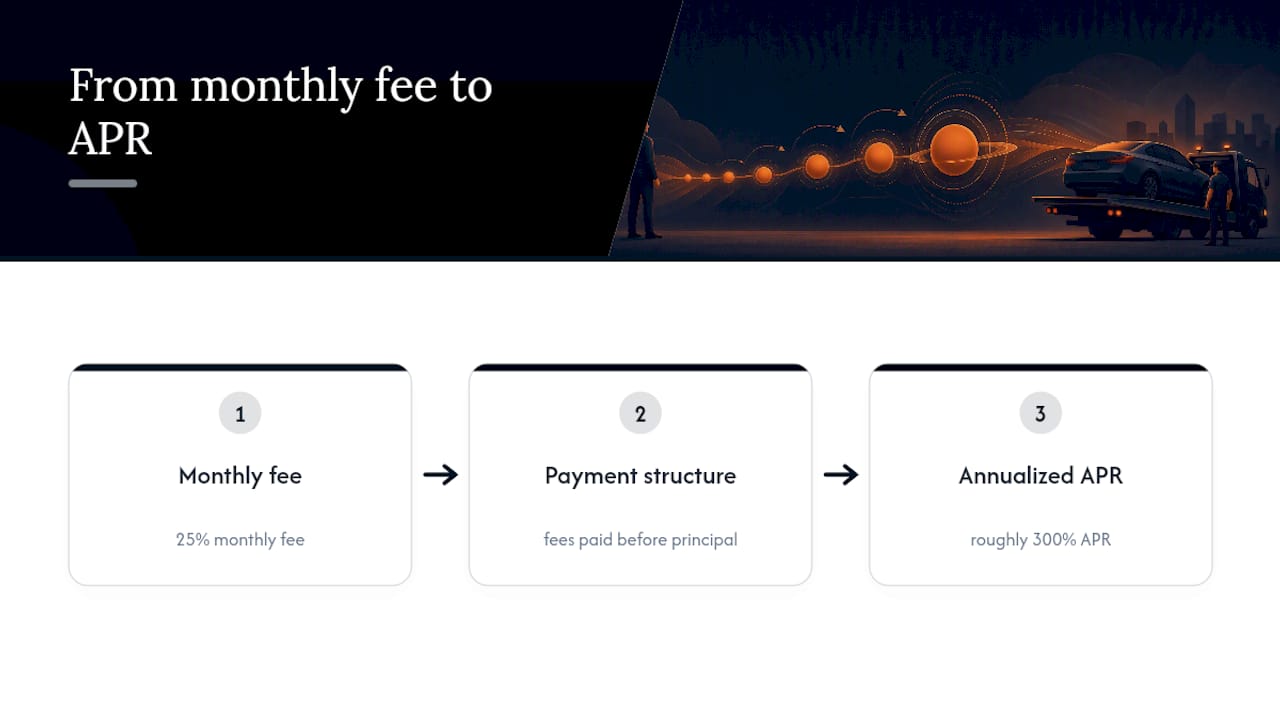
Where conventional advice falls short is treating all title loans as identical. State law changes the entire risk profile: a rollover-heavy, deficiency-judgment state is a different animal than a non-recourse state with capped fees. The CFPB’s own research on repeat borrowing backs this up. Structure, not just rate, drives repeat debt.
My take: prioritize the written terms over the marketing pitch. Ask for the total dollar cost of the full term in writing before you compare lenders on rate alone. A transparent online process that shows you the offer before you commit beats a storefront conversation every time, simply because you can walk away and think it over.
— Constantine
Ready to See Your Title Loan Offer?
Cash Title Express offers an online application process where you can apply and receive a written offer with no obligation, while keeping your car and working with licensed lenders. Some lenders may not charge prepayment penalties if you pay off early.
Before you start, gather your clear vehicle title, a photo ID, and proof of insurance. Have your vehicle’s mileage and condition details handy too, since that speeds up the valuation step. When you’re ready, start your online application or check state-specific requirements first if you want to know exactly what your state allows before you apply.
Where to Verify the Rules Yourself
The FTC’s consumer guidance explains typical loan terms and fee structures in plain language. The CFPB research brief documents repeat-borrowing patterns nationally. Report suspected lender fraud directly to the FTC if a lender misrepresents its terms.
This article is general information, not a substitute for advice from a qualified financial advisor. Consult a qualified financial professional about your own circumstances before acting on anything here.
Sources
- What to know about payday and car title loans — FTC
- How title loans work — ProPublica
- Consumer use of payday, auto-title, and pawn loans — CFPB research brief
FAQ
What Disqualifies You From Getting a Title Loan?
The most common disqualifier is not owning your car outright. If there’s already a lien on the title from an existing auto loan, most lenders won’t approve a title loan against it. Some states also disqualify certain vehicle types or require a minimum vehicle age or value.
How Much Money Do You Typically Get From a Title Loan?
Lenders generally lend 25% to 50% of your vehicle’s appraised value, though the exact amount depends on the lender’s valuation method and your state’s caps.
How Much Does a Typical Short-Term Title Loan Cost?
Monthly finance fees on title loans commonly run up to 25%, which works out to an APR near 300% once annualized. A $1,000 loan can cost $250 in fees for just one 30-day term, before any rollover.
What Happens If You Never Pay Back a Title Loan?
The lender can repossess and sell your vehicle, often without going to court first, depending on your state’s laws. Depending on where you live, you might still owe the difference if the sale doesn’t cover the debt, or you might be entitled to any surplus if it sells for more.
Does Cash Title Express Require You to Give Up Your Car?
No. Cash Title Express matches borrowers with licensed lenders while letting you keep driving your vehicle throughout the loan term. The lender holds a lien on the title, not the car itself.