
300% APR or Repossession: Title Loan vs Personal Loan in the U.S.

A personal loan is almost always the safer, cheaper choice, especially for anyone with fair-to-good credit or access to a credit union. A title loan can make sense only when you’re locked out of every other credit source and need cash within hours, because you’re pledging your car as collateral against loans that often carry APRs near 300%. Before you sign anything, check whether a credit union small-dollar loan or a low-rate personal loan can cover the gap first.
TL;DR:
- Title loans typically have APRs near 300% and demand full repayment within a few weeks, increasing the risk of repossession if payments are missed.
- Personal loans generally offer lower costs, longer repayment terms, and the ability to build credit, although approval takes more time and relies on creditworthiness.
- Repeated rollovers of title loans lead to escalating fees and a high likelihood of vehicle repossession, with one in five borrowers losing their car due to nonpayment.
- Safer alternatives include credit union payday alternative loans, small-dollar bank loans, or negotiating hardship extensions with creditors before resorting to a title loan.
- When considering a title loan, verify licensing, demand clear fee disclosures, and understand the repossession process to avoid falling into debt traps.
Table of Contents
- Title Loan vs Personal Loan: How a Title Loan Actually Works
- Title Loan vs Personal Loan: What a Personal Loan Looks Like
- Title Loan vs Personal Loan: Side-by-Side on Cost, Speed, and Risk
- What a $700 Title Loan Actually Costs vs a $1,000 Personal Loan
- The Real Risk: Repossession and the Reborrowing Cycle
- Safer Alternatives Before You Pledge Your Car
- Your Pre-Signature Checklist for Either Loan Type
- Why the CFPB Data Should Change How You Borrow
- If You Do Need a Title Loan, Here’s What to Look For
- Sources
- FAQ
Title Loan vs Personal Loan: How a Title Loan Actually Works
A title loan uses your vehicle’s title as collateral. You hand over the title (sometimes with a duplicate set of keys), the lender puts a lien on the car, and you keep driving it while you repay the debt. Miss payments, and the lender has legal grounds to repossess the vehicle and sell it to recover the loan balance.
Most title loans are structured as a single balloon payment due in a short term of a few weeks, though some states allow installment versions that stretch over a longer period. Lenders size the loan against the car’s value rather than your credit score, which is why approval is fast and why people with damaged credit gravitate toward this product. Typical loan amounts run around $700, though Cash Title Express and similar lenders can go higher depending on the vehicle and state.
What you’ll typically need to apply:
- A vehicle title free of liens (or close to paid off)
- A government-issued ID and proof of income
- Proof of residency and, often, vehicle insurance
- The car itself, or photos of it, for an online valuation
Funding is usually same-day once your title loan requirements are verified and the offer is signed.
Title Loan vs Personal Loan: What a Personal Loan Looks Like
A personal loan is money borrowed based mainly on your creditworthiness rather than an asset you own. Most are unsecured, meaning there’s no collateral backing them, and lenders look at your credit score, income, and debt-to-income ratio to decide how much to lend and at what rate.
Unsecured personal loans typically repay over one to five years in fixed monthly installments, and on-time payments get reported to the credit bureaus, which can help build your credit history over time. Secured personal loans exist too, backed by savings accounts, certificates of deposit, or occasionally a vehicle, and they tend to carry lower rates because the lender has less risk.
Key differences in qualification and speed:
- Unsecured loans lean heavily on your credit score and income documentation.
- Secured loans require an asset but usually unlock better rates and larger amounts.
- Approval can take anywhere from same-day to a few business days, depending on the lender and whether income verification is automated.
- Funds typically land in your bank account by direct deposit rather than cash in hand.
The personal loan advantages here are obvious: lower cost, longer runway to repay, and a chance to improve your credit along the way.
Title Loan vs Personal Loan: Side-by-Side on Cost, Speed, and Risk
The gap between these two products isn’t subtle once you line them up.
Cost. Title loans commonly carry finance charges that translate into APRs around 300%. That’s not a small gap. It’s the difference between paying a few hundred dollars in interest over a year and paying more in interest than you originally borrowed.
Repayment schedule. Title loans typically demand one lump payment in 15 to 30 days, which is a brutal ask if your cash-flow problem hasn’t resolved itself by the due date. Personal loans spread the balance over fixed monthly payments across one to five years, which keeps each payment smaller and more predictable.
Approval and speed. Title loans approve almost anyone with a clear vehicle title, regardless of credit history, and funding often happens the same day. Personal loans require a credit and income check, so approval odds depend heavily on your credit profile, though many online lenders and credit unions now fund within one to two business days.
Consequences of default. This is where the risk profiles diverge sharply. Default on a title loan and the lender can repossess your car, full stop. Default on an unsecured personal loan and you’ll face collections calls, credit score damage, and possibly a lawsuit, but you keep your vehicle and your ability to get to work.
Here’s the practical read: if you have any access to a personal loan, even at a mediocre rate, it beats a title loan on nearly every axis except pure approval speed for bad-credit borrowers. Title loans exist for the narrow case where speed and lack of credit history matter more than cost, and even then, they demand caution.

What a $700 Title Loan Actually Costs vs a $1,000 Personal Loan
APR measures the full yearly cost of borrowing, including interest and most fees, which makes it the only honest way to compare a title loan against a personal loan. A flat monthly finance charge sounds small in isolation, but annualized, it often reveals a different story.
Statistic to remember: the FTC notes that title loan finance charges often work out to an APR near 300%, while typical personal loans for creditworthy borrowers top out around 36% APR.
Roll it over twice because you can’t pay the lump sum, and you’ve paid $525 in fees on a $700 loan without touching the principal.
Origination fees, add-on products, and rollover charges push title loan costs higher still, and every renewal restarts the clock on fees. One protection worth knowing: the Military Lending Act caps the Military Annual Percentage Rate at 36% for covered servicemembers on many short-term loans, title loans included.
The Real Risk: Repossession and the Reborrowing Cycle
Title loans aren’t just expensive. They carry a documented risk of losing your car entirely.
One in five borrowers who take out a single-payment auto title loan has their vehicle repossessed for failing to repay the debt, according to Consumer Financial Protection Bureau research. That same research found more than four in five single-payment title loans get renewed rather than paid off outright.
That reborrowing pattern is what turns a short-term loan into a long-term burden. Each renewal adds another round of fees on top of a balance that hasn’t shrunk.
Watch for these warning signs before you sign:
- Lenders that push repeated rollovers instead of a payoff plan
- Vague answers about repossession timelines or fees
- GPS trackers or remote kill switches disclosed only after you ask
- No clear written breakdown of total cost if you renew
Losing a vehicle over a $700 loan means losing your commute, and for a lot of people, that means losing income too.
Safer Alternatives Before You Pledge Your Car
Most people who end up at a title lender aren’t there by preference. They’re cash-constrained and assume mainstream credit isn’t an option. It often still is.
- Check your credit union for a Payday Alternative Loan (PAL), which the FTC recommends as a far cheaper small-dollar option than title lending.
- Ask your bank about small-dollar loan programs, many of which now offer fast approval for existing customers.
- Call your creditors first. Utility companies, landlords, and medical providers frequently offer hardship extensions or payment plans if you ask before you’re late.
- If you’re already stuck in a title loan, a low-rate personal loan can pay it off and stop the fee cycle.
Pro Tip: Call two credit unions before you call any title lender. PALs often approve within a day and cap fees far below what a title loan charges.
A title loan still has a defensible place in genuine emergencies when there is no other funding source and you have a realistic plan to repay within the loan term.
Your Pre-Signature Checklist for Either Loan Type
Run the numbers before you commit to either product.
- Can you afford the monthly payment (or lump sum) without missing rent, utilities, or food?
- What’s the exact APR, including every fee, not just the advertised rate?
- What happens if you’re late, and specifically, what’s the repossession timeline for a title loan?
- Does the lender report to credit bureaus, and are there prepayment penalties?
- Is the lender licensed in your state? Check NMLS Consumer Access before signing anything.
If a lender doesn’t answer these plainly, walk away. For a true emergency, the rule of thumb is simple: exhaust every lower-cost option first, and treat a title loan as the last door, not the first one.
Why the CFPB Data Should Change How You Borrow
The CFPB’s repossession and reborrowing numbers aren’t abstract statistics. They describe what happens to real borrowers who thought a short-term fix would stay short-term. Title loans have a place, but only for genuine emergencies with a clear repayment plan.
Run the checklist above before you sign anything, and give a credit union or personal loan lender a real chance first.
— Constantine
If You Do Need a Title Loan, Here’s What to Look For
If you’ve checked every safer option and a title loan is genuinely your best remaining move, the lender you choose matters as much as the product itself. Some lenders run the entire process online, offer a range of loan amounts, and allow you to keep driving your car while you repay. Same-day funding can be available once your offer is signed, and licensed lenders may be matched to your state’s specific requirements rather than a one-size-fits-all rate.
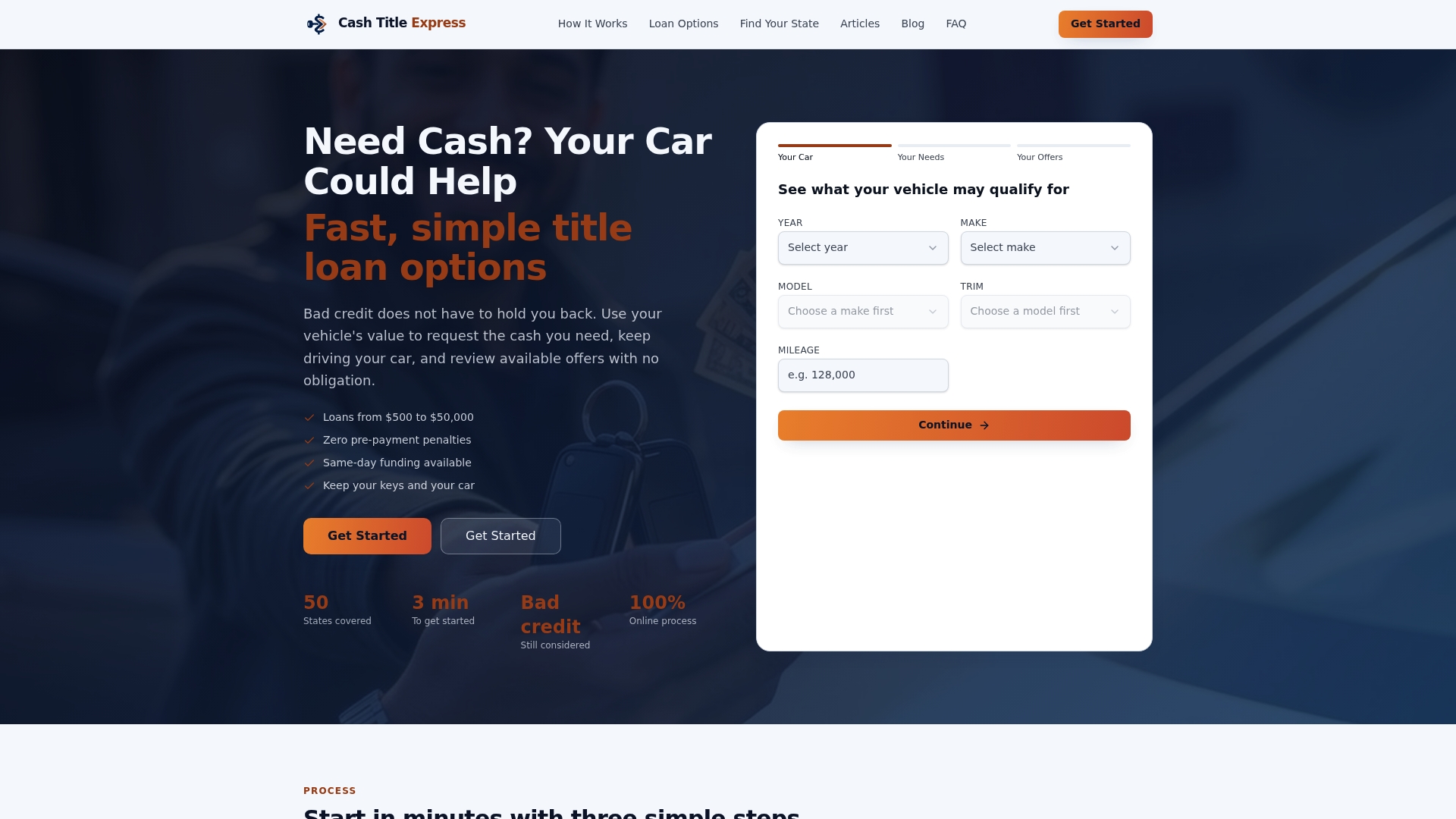
Before you accept any offer, whether from Cash Title Express or another lender, insist on an itemized breakdown of fees, written confirmation that there’s no prepayment penalty, and a clear explanation of the repossession process if payments slip. Cash Title Express provides a no-obligation offer review, so you can see the full terms before deciding anything. Start the online application to see what your vehicle qualifies for and get a written offer with no pressure to accept it.
Sources
For readers who want the primary data behind this comparison: the CFPB’s repossession findings and its research brief on single-payment title lending cover repossession and reborrowing rates in detail. The FTC’s consumer guidance explains APR comparisons and safer alternatives. Use NMLS Consumer Access to verify any lender’s license before signing.
This article is general information, not a substitute for advice from a qualified financial advisor. Consult a qualified financial professional about your own circumstances before acting on anything here.
- CFPB finds one-in-five auto title loan borrowers have vehicle seized for failing to repay debt
- Single-Payment Vehicle Title Lending (CFPB research brief)
- What to know about payday and car title loans
- NMLS Consumer Access
FAQ
How much would a $10,000 personal loan cost per month?
A shorter term or lower rate, which is common for borrowers with strong credit, cuts that monthly figure significantly while raising it if you extend to a longer repayment period.
What are the downsides of getting a title loan?
The biggest downside is repossession risk. CFPB research found that about one in five title loan borrowers lose their vehicle for failing to repay, and the triple-digit APRs mean the debt can balloon fast if you renew instead of paying it off.
Why do some people call title loans illegal?
Title loans aren’t illegal nationwide, but several states ban or tightly cap them because of the high APRs and repossession rates, while other states permit them under specific licensing rules. Legality and terms vary by state, so checking a lender’s license through NMLS Consumer Access is the safest way to confirm it’s operating legally where you live.
Can I borrow more money on a title loan?
Some lenders allow you to refinance or add to an existing title loan if your vehicle’s value supports it, but doing so restarts fees and extends the debt-trap risk that CFPB data already flags as common. If you need more cash, comparing a personal loan or a fresh, transparent offer through a platform like Cash Title Express is usually a safer move than stacking debt on the same collateral.
Which is better, a title loan or a personal loan, for emergency cash?
A personal loan is better for almost everyone because it costs far less and doesn’t put your car at risk. A title loan only makes sense when you have no access to a personal loan, credit union PAL, or other low-cost option and need funds within hours.