
Electronic Title Loan: How It Works With an E-Title
By Cash Title Express Editorial Team · Reviewed

An electronic title loan is a car title loan secured by a vehicle whose title exists as a record in the state’s database instead of a sheet of paper. You still borrow against your car’s value, you still keep driving it, and the lender’s claim is recorded electronically as a lien. If your state already holds your title electronically, or the lender can convert a paper title, you can complete the whole request online. Cash Title Express matches car owners with licensed lenders for loans from $500 to $50,000, with a fully digital process, same-day funding and a written offer you are free to decline.
TL;DR
- An “electronic title” is a state record. The lender’s lien is entered in that record, so nobody has to mail or hold a paper certificate.
- You keep and use your car during the loan. The lien only shows that the lender has a claim until the loan is repaid.
- Paper titles with a lien can usually be converted to electronic by the lienholder. Rules and fees differ by state.
- Before accepting any offer, read the rate, monthly fees, late charges and default terms in writing. Our offers come with no pre-payment penalty and no obligation to accept.
- At payoff, the lender releases the lien electronically and the state prints your clear paper title.
Table of Contents
- What an electronic title loan actually is
- Do you keep driving your car?
- How the process works, step by step
- Converting a paper title to electronic
- Which states use electronic titles?
- What to read in your written offer
- Bad credit and electronic titles
- Selling or refinancing while the lien is on file
- Start with a written offer
- FAQ
- Sources
What an electronic title loan actually is
A car title loan uses your vehicle as collateral. The lender records its claim on the title, which is called a lien, and removes it when you repay. On paper titles, the lender traditionally held the document or its name was printed on it. On an electronic title, the same information lives in the motor vehicle agency’s database.
The American Association of Motor Vehicle Administrators describes the electronic lien and title (ELT) system as a way for lienholders and motor vehicle agencies to exchange information electronically to record, update and release liens on vehicle titles. A lender can also tell the agency electronically when it releases its interest.

For you as a borrower, that means three practical things. There is no certificate to courier to a store. The lien is recorded faster. And the release at payoff does not depend on a piece of paper getting back to you.
There is no separate legal product called an “electronic title loan.” It is an ordinary title loan, made in a state where the title record is electronic. Your loan terms are still set by the lender and your state’s law.
Do you keep driving your car?
Yes. With an electronic lien, the lender holds a recorded claim, not your car. Our loans are built around you keeping and using your vehicle during the loan, and you can read more in our guide on whether you keep driving your car during a title loan.
Washington’s Department of Licensing explains the mechanics: under its optional program, lenders can hold an electronic title record instead of a paper title for the duration of the lien. After the lender releases the lien electronically, the department prints a paper title and mails it to the owner.
A few states are “owner-retained” states, where the borrower keeps the paper title but it must list the lender as lienholder. Tower Federal Credit Union explains the difference between the two models. Either way, registration and daily use continue as before.


How the process works, step by step
Here is the routine from first click to funded loan, and what to watch at each step.
1. Check that the title is in your name
The lender needs to see that you are the owner of record and that the vehicle can carry a lien. Have your driver’s license, the vehicle details and your registration ready. Our car title loan requirements page lists the title, vehicle and income items in one place.
If your name is misspelled on the title or the paper copy is missing, fix that first. We cover it in title loans with a lost or incorrect title. If you ever need to show ownership documents in person, a guide on bringing proof of ownership shows what to carry and how to keep personal details protected.
2. Find out whether your title is paper or electronic
Most people do not know which they have. Look at your state motor vehicle agency’s account page, or the last notice you received about the title. If you have a paper title with no lien, the lender can usually record its lien and the state will issue or hold the record electronically. If you already have a lien from a car loan, see our page on qualifying for a title loan with an existing lien.
3. Submit your request online
You enter your vehicle and contact details on our online car title loan page. We match the request with licensed lenders according to your state’s requirements. You then receive a written offer. Reading it costs nothing and you are under no obligation to accept.
4. Review the written offer
This is the step that protects you. Read the amount, the rate, any monthly fee, the late charge, what happens if you miss a payment, and confirm there is no pre-payment penalty. The next section shows exactly what to look for.
5. The lender records the lien and funds the loan
If you accept, the lender enters its lien. In an ELT state that is an electronic transmission to the motor vehicle agency, with no paper certificate changing hands. Same-day funding is our goal for qualifying requests; see same-day title loan funding for the timeline and rules.
6. Repay and get the lien released
When the balance reaches zero, the lender releases the lien. Pennsylvania’s PennDOT, for example, says the lienholder must perform the electronic release immediately at payoff, after which PennDOT prints and mails the paper title to the owner the next business day. Our guide to confirming your lien is cleared walks through the check.
Converting a paper title to electronic
Readers often ask how to convert a paper title. The honest answer: it depends on the state, and in a loan the lienholder usually handles it.
| State | What the official page says |
|---|---|
| Pennsylvania | The lienholder can convert a paper title with a lien to an electronic title with the lien intact. |
| Florida | An electronic title stays electronic until a paper title is requested. An owner with no lien can convert to paper through the MyDMV Portal for $4.50, and the paper title generally arrives in 3 to 4 weeks. |
| Oklahoma | Owners can convert to an electronic title before a transaction, online or in person. Published fees in the May 2025 FAQ are $10 for the lien and $11 for title issue. |
| Indiana | Since July 1, 2025, customers state a preferred title format. It is honored only when no lien is recorded; with a lien, the lienholder’s preference governs. |
Two things to keep straight. First, fees are the state’s and change; check your agency’s page for the current figure. Second, converting is usually part of the lien being recorded, so you do not need to convert before you ask for an offer.
Oklahoma shows how far the shift has gone. As of July 1, 2025, all titles with an active lien are issued electronically there, and existing paper titles stay valid until a sale, transfer or lien placement triggers a change.
Which states use electronic titles?
Most do in some form, but the rules differ. AAMVA’s May 2026 survey of state electronic titling laws lists laws in Illinois, Pennsylvania, North Carolina, Michigan, Nevada and Wisconsin, among others, and notes that Texas’s program is voluntary. Some states require lenders to use ELT; others let them choose.
That difference matters for title lending. Virginia’s DMV says banks and financial institutions with 50 or more liens a year must transmit lien information electronically, while motor vehicle title lenders under Chapter 22 are not eligible for its e-lien program. So in Virginia a title loan may still involve a paper process even though the wider system is electronic.
This is why we match you by state. Licensed lenders follow your state’s requirements, and what applies in Florida is not what applies in Virginia. Our state laws guide lists three details to verify, and you can browse title loans by state and city.

What to read in your written offer
Because there is no federal ability-to-repay rule for these loans (the CFPB revoked those provisions in a final rule effective October 20, 2020), your state’s law and the offer itself set your protections. Read these lines every time:
- Interest rate and how it is stated. Look for the annual rate, not only a monthly figure.
- Monthly or maintenance fees. Virginia, as one example, caps the monthly maintenance fee at the lesser of 8% of the original loan amount or $15.
- Late charges. Virginia’s cap is $20.
- Default and repossession terms. Virginia requires a written default notice 10 days before repossession and a 15-day notice before sale.
- Pre-payment terms. Ours carry no pre-payment penalty, so paying early shortens the loan without extra cost.
Those Virginia figures come from Chapter 22 of the Code of Virginia, which also caps interest at a simple annual rate of 36% and bars lenders from requiring or accepting your keys. They are one state’s rules, not a national standard. Your state’s numbers may differ, and your offer states which apply.
Plan the repayment before you accept. If a loan goes into default, the CFPB explains that you may owe a deficiency balance, the difference between what remains on the loan plus repossession costs and the sale price. Borrow what your budget can repay on schedule. If a payment looks hard to make, contact the lender before the due date.
Bad credit and electronic titles
The title is the collateral, so approval centers on the vehicle and your ownership, not only your credit score. Our page on how bad credit approval works explains what lenders look at. Electronic recording does not change who qualifies; it changes how the lien is recorded.
Selling or refinancing while the lien is on file
An electronic lien is a record the lender must clear before the title can move to a buyer. If you plan to sell, see selling a car with an outstanding title loan. Idaho’s transportation department notes that refinancing between two electronic lienholders carries no title fee there, one example of how electronic records simplify changes. For a cleanup after payoff, our guide to removing a title loan lien covers each step.
Our view
We built Cash Title Express around a simple idea: a borrower should see the terms before committing to anything. That is why every request ends in a written offer that you can accept or walk away from.
The electronic title shift helps. A lien recorded in a database is quicker to place and quicker to clear than one tied to a mailed certificate, and it fits a process that happens entirely online. You keep your car, you keep driving it, and early repayment carries no pre-payment penalty.
The state still decides the rules, so we only match you with lenders licensed for your state’s requirements. Read the offer, compare it to your budget, and accept only what fits.
Steve
Wait, correction to the line above.
Start with a written offer
If you own your car and need cash, you can request loans from $500 to $50,000 through our online car title loans page. The process is fully digital, you receive written terms with no obligation to accept, and you keep your car during the loan.
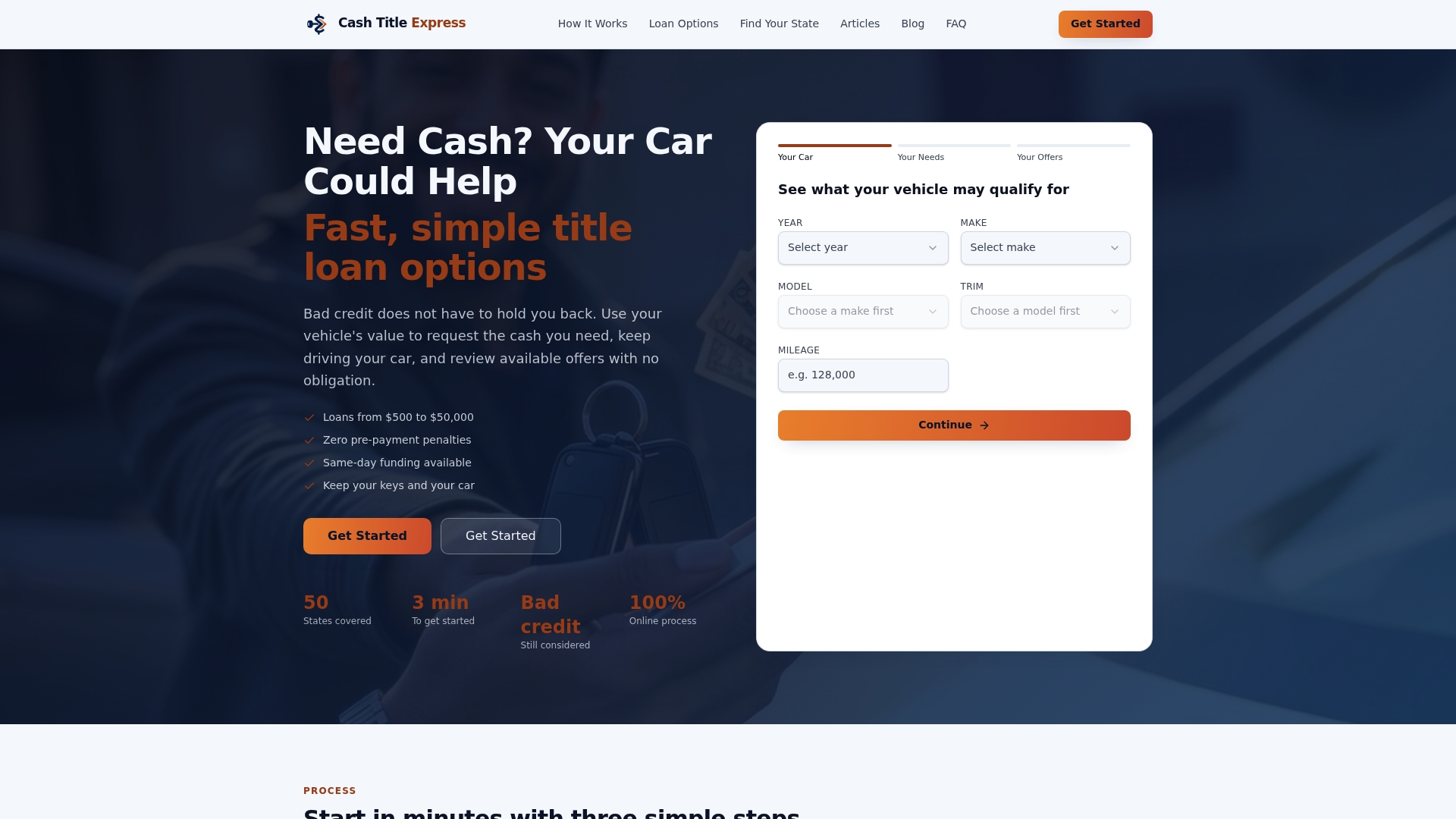
You can also start from the Cash Title Express home page.
FAQ
Can I get a title loan with an electronic title?
Yes. The lender records its lien in the state’s electronic title record, so you do not need to mail a paper certificate. State rules differ, so we match you with lenders licensed for your state.
How do I convert a paper title to an electronic title?
Usually the lienholder does it when the lien is recorded. Pennsylvania, for example, lets the lienholder convert a paper title with a lien while keeping the lien intact. Fees and steps for owners without a lien are set by each state’s motor vehicle agency.
Do I get a paper title after I repay?
In most electronic states, yes. The lender releases the lien electronically and the state prints and mails a clear paper title. Timing varies: Pennsylvania mails it the next business day, while Florida’s owner-requested paper titles generally take 3 to 4 weeks.
Is there a penalty for paying off early?
Not with our loans. They carry no pre-payment penalty, and you can review the written terms before deciding.
Sources
- AAMVA: Electronic Lien and Title
- Washington DOL: Electronic titles
- Tower Federal Credit Union: vehicle title, lien and registration
- PennDOT: Mandatory Electronic Lien and Titling FAQs
- Florida FLHSMV: Electronic Liens and Titles
- Oklahoma ELT FAQ for lienholders
- Indiana BMV: Electronic Titles Overview
- Service Oklahoma: Electronic Titles
- AAMVA: electronic titling laws survey, May 2026
- Virginia DMV: Electronic Lien Program FAQ
- Federal Register, July 22, 2020: CFPB final rule
- Code of Virginia, Chapter 22
- CFPB: What happens if my car is repossessed?
- Idaho ITD: ELT Fact Sheet