
Online vs. In-Store Title Loans: How They Differ

The main difference between online and in-store title loans is where the work happens. Online, you submit your information, vehicle details and ownership documents digitally and review a written offer on your own time. In a store, you bring the car and paperwork to a branch and deal with a clerk in person. The loan itself works the same way either way: your car title is the collateral, you keep driving the car, and the lender can repossess it if you fall behind. Cost, state law and the lender’s license matter far more than the channel.
TL;DR
- Online and in-store title loans use the same collateral model. The channel changes convenience and paperwork, not the basic risk.
- Online applications let you submit documents digitally and compare a written offer without sitting in a branch. Inspection and documentation rules depend on the lender and your state.
- Costs are high in both channels. Federal research found typical single-payment title loans carried an APR of about 300%, so compare the total repayment amount, not just the monthly payment.
- Title lending is legal only in some states, and a lender must be licensed where you live, whether it has a storefront there or not.
- Before you accept, read the written terms, confirm the license, and make sure you can repay without renewing.
Table of Contents
- How the two application routes work
- Speed: how fast can you get the money?
- Requirements: what you need either way
- Cost: the part that matters most
- State rules shape both channels
- Keeping your car, and what happens if you miss payments
- Which one fits you?
- Our perspective
- Start online with a no-obligation offer
- What to check before you accept any offer
- FAQ
- Sources
How the two application routes work
A title loan is a secured loan. You hand over the right to take your car, not the car itself, and the lender places a lien on the title until you repay. The CFPB’s report on single-payment vehicle title lending describes loans that generally run about a month, with the borrower keeping use of the car while the loan is outstanding.
In-store applications
In a storefront you typically bring your title, a government ID, proof of income and proof of residence, and the lender looks at the car in person. The branch can appraise the vehicle on the spot, and you can ask a staff member to walk through the paperwork. The trade-off is the trip, the wait during business hours, and the fact that you are making a decision at a counter, sometimes under pressure.

Online applications
Online, the same pieces move to a form. According to one industry overview, online borrowers may submit personal information, vehicle details, proof of ownership and other documents digitally, while inspection or documentation can still depend on the lender and the state. In practice that means you may upload photos of the car, a copy of the title and your ID, and then receive an offer to read before you commit.
That last part is the real advantage: you can read the terms at your kitchen table, compare more than one offer, and walk away without anyone watching you decide. Our online car title loans process is built around that, with a written offer you have no obligation to accept.
Speed: how fast can you get the money?
Both channels can be fast, and neither one guarantees a time. In a store, funding often happens the same visit once the car is appraised and the contract is signed. Online, the clock depends on how quickly you upload documents, whether the lender needs an inspection or extra verification, how fast the lender reviews them, and how your bank or the payout method handles the transfer. Cutoff times and weekends can push funding to the next business day.
For a realistic picture of the steps and what can slow them down, see our guide to same-day title loan funding. A clean title, a clear photo set and complete documents are the most controllable factors.
Requirements: what you need either way
The core requirements are shared across channels:
- A title in your name. In Texas, for instance, the state’s consumer credit regulator notes that title-loan customers generally must have an unencumbered vehicle title.
- A vehicle that can be valued. Lenders typically want to know the make, model, year, mileage and condition.
- ID and proof of residence in the state where the loan is made.
- Proof of income or ability to repay, which varies by lender and state.
If your car still has a lien, the answer depends on the lender. Many require a lien-free title, and some may work with a remaining balance in certain situations. We explain the options in our piece on how to qualify for a title loan with a lien, and our overview of car title loan requirements covers the full document list.
Cost: the part that matters most
Choosing online over in-store does not make a title loan cheap. Costs are driven by the state, the lender and the loan structure.
The CFPB’s 2016 research found a typical auto-title loan of about $700 and a typical APR of about 300% for a single-payment loan. Its research highlights report puts installment auto-title loans at about 259% APR. The Federal Trade Commission gives a simple example: borrowing $1,000 for 30 days at a 25% fee means repaying $1,250.
Those figures are older federal research, and your actual rate depends on your state and lender. Use them as a yardstick when reading your own offer.
A quick comparison
| Factor | Online | In-store |
|---|---|---|
| Where you apply | From home, by phone or computer | At a branch |
| Documents | Uploaded digitally | Handed over in person |
| Vehicle check | Photos or other verification, depending on lender and state | Often an in-person look |
| Reading the terms | On your own time, easy to compare offers | At the counter |
| Face-to-face help | By phone or chat | In person |
| Cost | Set by lender and state law | Set by lender and state law |
| Repossession risk | Same | Same |
State rules shape both channels
Title lending is not legal everywhere. The CFPB’s research highlights report says 25 states permitted some form of auto-title lending: seven allowed only single-payment loans, 13 allowed either structure and five allowed only installment loans. Laws change, so check your state’s current rules.

State and even city rules can be specific. In Texas, the regulator reports that terms are limited to 180 days or less while APRs can routinely exceed 400%. Houston’s city rules for credit-access businesses cap a title extension at the lesser of 3% of gross annual income or 70% of the vehicle’s retail value, limit repayment to four installments and restrict refinancing and renewals.
For online borrowing, the key question is licensing. A Virginia legal aid guide explains that online title lending is lawful there only when the company is licensed by the State Corporation Commission, even without a physical office in the state, and warns that resolving problems can be harder with an out-of-state online lender. Put simply: a website is not a loophole, and a lender serving you must hold the license your state requires. Our guide to checking an online title lender’s license walks through the steps, and our overview of title loan state laws lists the details to verify. If you recently moved, read about out-of-state title loans.
California’s financial regulator, for example, notes that for loans under $10,000 made under a California Financing Law license, interest charges are capped, while state law does not limit rates on loans of $10,000 or more. That kind of difference is why the same loan size can cost very different amounts in different states.
Keeping your car, and what happens if you miss payments
With either channel, you generally keep driving the car. The CFPB’s report says borrowers retain use of the vehicle while the loan is outstanding, and that the lender can repossess and sell it after untimely payment. Our articles on whether you keep driving your car and how to keep your car with a title loan cover the practical side.
The bigger risk is rollover. The CFPB found that more than four in five single-payment title loans were renewed on the due date, and more than half involved four or more consecutive loans. In its study of installment-loan sequences, the research highlights report found a 31% default rate and an 11% vehicle-seizure rate. Borrow only an amount you can repay from your next paycheck or two without renewing.
There are also situations where the title loan complicates life later, such as selling a car with an outstanding title loan or inheriting a car with a title loan. Plan for those before you sign.
Which one fits you?
Choose in-store if you want to sit across from someone, need to ask questions in person, or are unsure how to upload documents. Choose online if you want to read the terms without pressure, compare offers and handle everything from home. In both cases the decision rules are the same:
- Ask for the full written terms: loan amount, fees, APR, due date and total repayment.
- Confirm the lender’s license for your state.
- Ask whether there is a prepayment penalty. Paying early should never cost extra.
- Check what happens if you cannot pay on the due date.
- Borrow the smallest amount that solves the problem.
Our perspective
We built our platform around the idea that the hardest part of a title loan is not getting the money, it is understanding what you are agreeing to. When you apply online, you can see written terms before you commit, take the time to read them and decide without anyone leaning over the counter.
That is why we focus on a fully online process with licensed lenders matched to your state’s requirements, no prepayment penalties and an offer review with no obligation to accept. You keep your car for daily use, and you are never asked to hand it over to get started.
A faster process only helps if it is also a clearer one. Our view is that the best title loan experience is one where the numbers are in front of you, the lender is licensed where you live and the repayment plan fits your budget before you sign.
Constantine
Start online with a no-obligation offer
If you want to see what a title loan could look like for your car, you can request an offer on our online car title loans page. Loan amounts range from $500 to $50,000, the process is entirely online, and you get written terms with no obligation to accept. Lenders are licensed and matched to your state’s requirements.
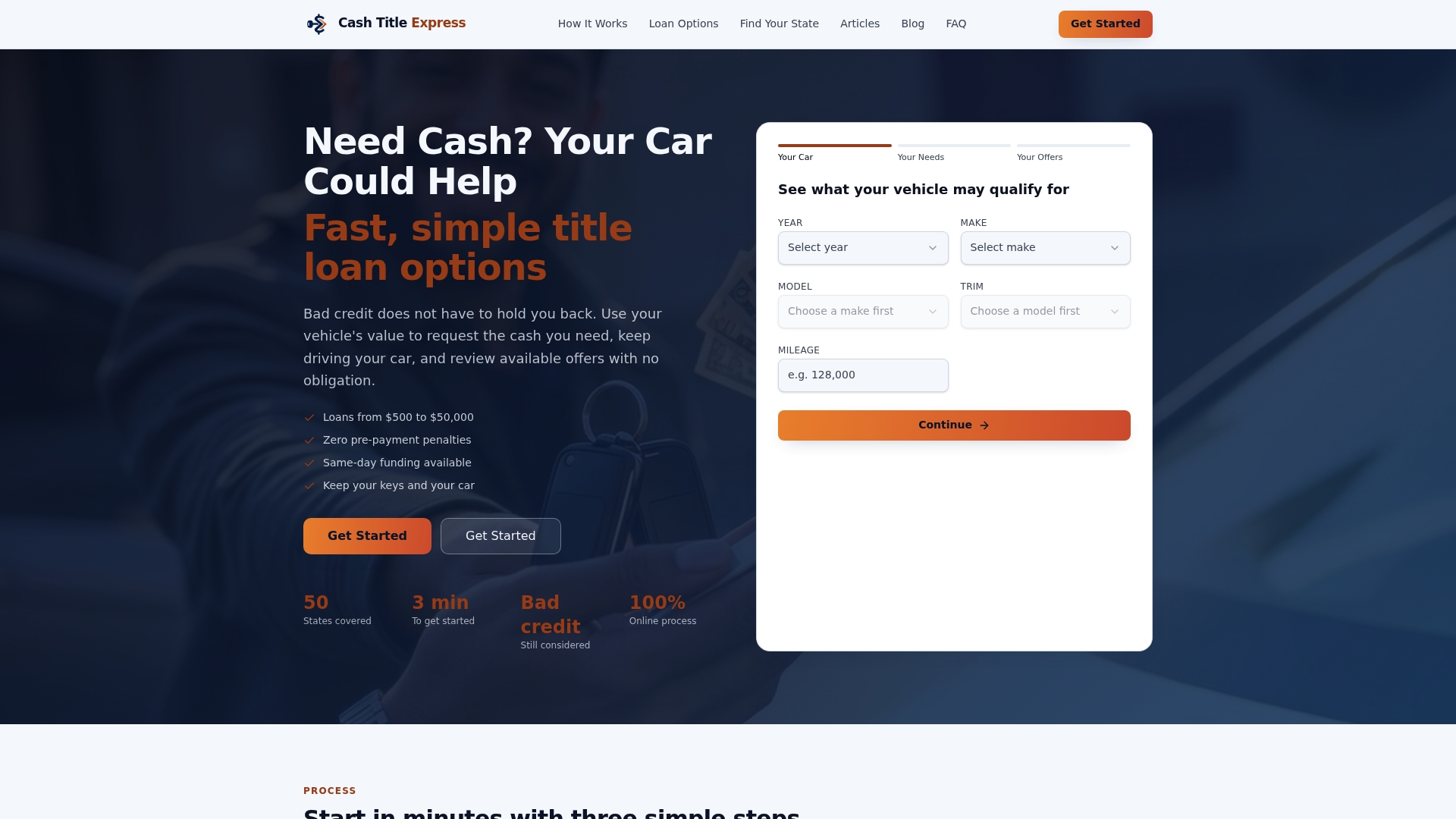
You can also begin from our home page or browse title loans by state and city to see what applies where you live.
What to check before you accept any offer
- The total repayment amount. Divide the cost of borrowing by the amount borrowed, and compare it with the APR shown.
- The due date and renewal terms. Ask exactly what a renewal costs. Renewals are where title loans get expensive.
- The license. Look up the lender with your state’s financial regulator.
- Fees. Ask about origination, processing, late and lien fees.
- Prepayment. Confirm in writing that early repayment carries no penalty.
- Repossession terms. Know when the lender can take the car and what happens to any sale proceeds above what you owe.
- Alternatives by type. Before pledging your car, compare other options such as a credit union small-dollar loan, a payment plan with the biller, or help from a local assistance program.
FAQ
Are online title loans cheaper than in-store title loans?
Not automatically. Rates and fees are set by the lender and limited by state law, not by the channel. Compare the APR, fees and total repayment on each written offer.
Do online title loans require a vehicle inspection?
It depends on the lender and the state. Some use photos or digital verification, and others require an inspection. Ask before you apply so there are no surprises.
Can I get a title loan if I still owe money on my car?
Often lenders want a lien-free title, and Texas regulators note customers generally need an unencumbered title. Some lenders may consider a vehicle with a remaining lien, depending on state and lender. Confirm this before applying.
Is an online title lender legal in my state?
Only if it is licensed where you live and title lending is allowed there. Virginia legal aid guidance, for example, says an online lender must be licensed by the state even without a local office. Check with your state regulator.
What happens if I cannot repay on time?
The lender can repossess and sell the car after an untimely payment, according to the CFPB. Contact the lender before the due date, ask about options and avoid renewing again and again.
Sources
- CFPB: Single-Payment Vehicle Title Lending
- CFPB: One-in-Five Auto Title Loan Borrowers Have Vehicle Seized
- CFPB: Payday Loans, Auto Title Loans, and High-Cost Installment Loans
- FTC: What you should know about payday loans and car title loans
- Texas OCCC: 2025 Report on Consumer Loan Products
- City of Houston: Credit Access Business regulations
- Central Virginia Legal Aid Society: Car title loan guide
- California DFPI: Automobile Title Loans, What Consumers Need to Know
- How Online Title Lenders Differ From Storefront Lenders